
The Two-Ask Split
How to turn “quick question” into a real deliverable in one message

It is 3:47 p.m., which is the time of day when your brain wants to be done but your inbox wants to be ambitious.
A Slack message arrives:
“Quick question—can you take a look at this?”
No subject. No context. Just a link. Possibly to a document. Possibly to a fire.
You click. It is a 19-page draft with comments, tracked changes, and one ominous highlight that says “???” in the margin.
You start reading. Then you realize you do not know what “take a look” means. You do not know whether they want a typo pass, a substantive critique, a yes/no approval, or a miracle.
So you do the thing everyone does: you guess.
And three hours later, they respond: “Thanks! But can you actually focus on the risks and give me a recommendation by tomorrow morning?”
This is not a time management problem. This is an ask-definition problem.
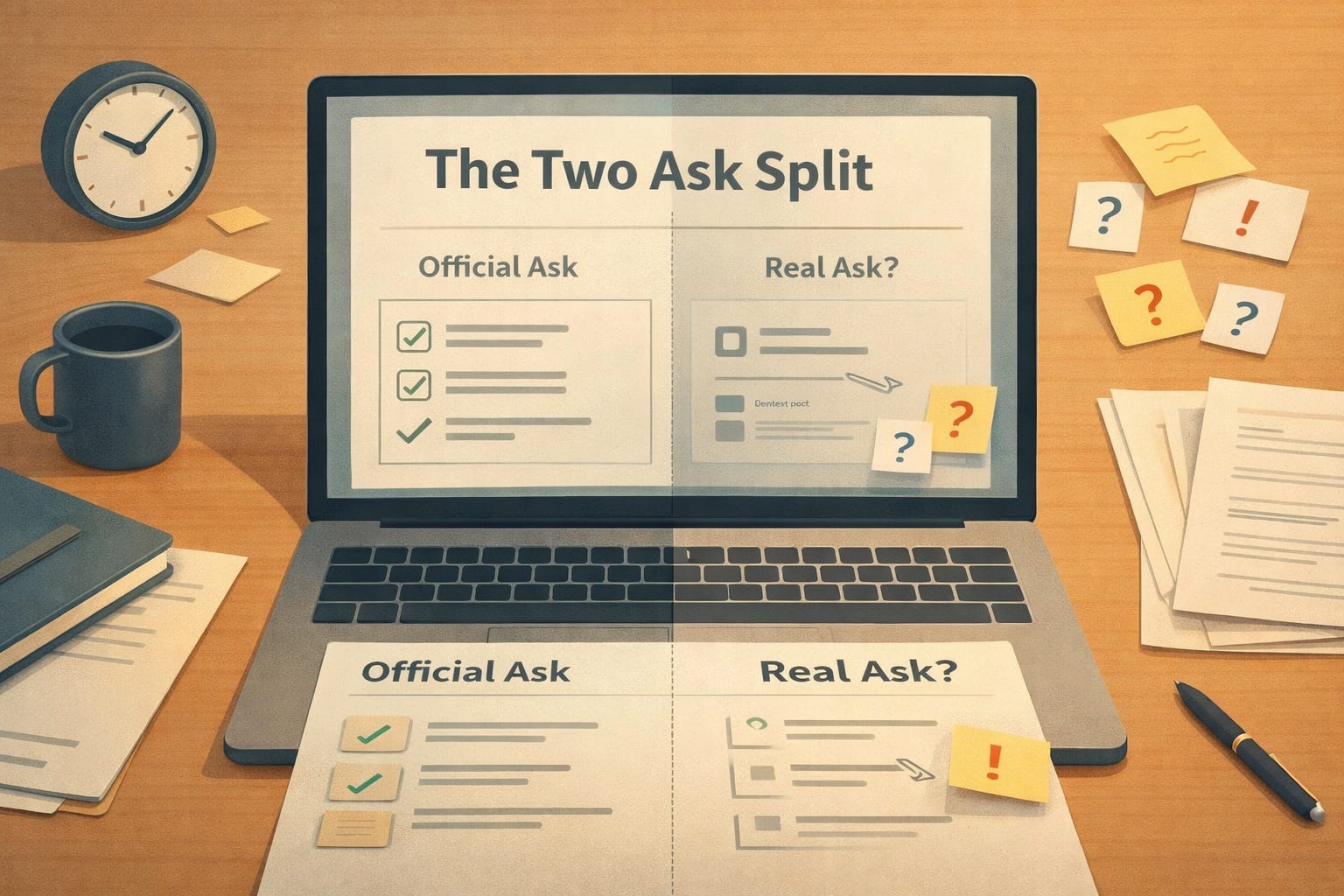
The Two-Ask Split (The whole trick)
Most vague requests contain two asks:
The Official Ask: what they wrote.
“Can you review this?” “Thoughts?” “Can you run with it?”
The Real Ask: what success requires.
What decision they need. What output they want. What “done” looks like. What risk they are nervous about.
These diverge for predictable reasons: time pressure, politics, ambiguity, and the universal human fear of asking for too much. People soften their requests because they want help without feeling needy, or because they are not sure what they need until you show them something.
The Two-Ask Split is simply this: extract both asks, then respond in a way that confirms which one you are solving.
If you do not, you will do excellent work for the wrong job.
Three Examples (Before → After)
1) Slack: “Can you review this?”
Original message:
“Can you review this before EOD?” [link]
Official Ask:
Review the document before EOD.
Real Ask (likely variants):
Variant A: Sanity check: “Is this defensible enough to send?”
Variant B: Risk scan: “What could blow up if we send this?”
Before reply (bad):
“Sure, I will take a look.”
After reply (good):
“Can do. Quick confirm: do you want a light pass (clarity + obvious issues) or a risk-focused review (top concerns + suggested fixes)? If risk-focused, what is the audience and the decision this supports?”
2) Email: “Thoughts?”
Original message:
“Attached. Thoughts?”
Official Ask:
Provide thoughts on the attachment.
Real Ask (likely variants):
Variant A: Permission: “Is this ready to go to the client/partner?”
Variant B: Positioning: “What is the key message and what should we cut?”
Before reply (bad):
“Looks good to me.”
After reply (good):
“Happy to. When you say ‘thoughts,’ are you looking for (1) a quick thumbs-up/ready-to-send check, or (2) substantive edits to strengthen the argument? Also, who is the target reader and what do you want them to do after reading?”
3) Meeting: “Can you take this and run with it?”
Original ask (spoken, end of meeting):
“Can you take this and run with it?”
Official Ask:
Own the task and make progress.
Real Ask (likely variants):
Variant A: Drive a decision: “Bring back a recommendation with options.”
Variant B: Do the dirty work: “Draft the thing so I do not have to.”
Before reply (bad):
“Yep, will do.”
After reply (good):
“Got it. Just to lock scope: do you want me to (A) draft a first version for your review, or (B) come back with 2–3 options and a recommendation? And what is the deadline and the ‘must-not-miss’ constraint?”
Notice what the “after” replies do. They do not over-question. They present a small set of plausible Real Asks and ask the requester to choose.
That is how you stay fast without guessing.
The Workflow (10 minutes)
Capture the message + minimal context
Paste the request and add two bullets: what you know about the project, and what is due (if anything).Extract the Official Ask
Write it in one sentence. If you cannot, the request is not an ask yet.Infer the Real Ask (2 plausible variants)
Do not aim for perfect mind-reading. Aim for two high-likelihood interpretations.Decide: clarify or proceed with assumptions
If guessing wrong creates rework or risk, ask 1–2 questions.
If stakes are low, proceed with explicit assumptions.
Draft the alignment reply
Restate the ask you will solve, offer a quick vs thorough option, and ask only what changes the work.Create a mini-checklist
What inputs you need, what you will deliver, and when.
This is the same logic as “do not let AI talk first”: you frame the job before the work begins. If you do not, you will get confident output for an undefined task.
The Prompts (Copy/Paste)
Two-Ask Extractor (template)
Prompt:
You are The AI Desk Mate. Extract the Official Ask and the Real Ask from the message below.
Context: [1–3 bullets of what this is about]
Message: [PASTE]
Output:
Official Ask (one sentence)
Real Ask (2 plausible variants)
What “success” likely means (3 bullets)
The 2 most important clarifying questions (only if needed)
Constraints: Audience is [AUDIENCE]. Format needed is [FORMAT]. Deadline is [DEADLINE]. Success criteria: [SUCCESS CRITERIA].
Reply Draft (template)
Prompt:
Draft a reply that confirms alignment without sounding pedantic.
Inputs: Official Ask: [OFFICIAL ASK]
Real Ask variants: [A] and [B]
Audience: [AUDIENCE]
Format: [Slack/Email]
Deadline: [DEADLINE]
Include: a quick vs thorough option, 1–2 clarifying questions max, and a clear next step.
If-you-only-use-one-line (ultra-busy)
Prompt line:
“Quick confirm: do you want [Option A] or [Option B], and what is the deadline/audience?”
When output is still fuzzy, run an anti-vague pass: force assumptions, headings, and concrete deliverables.
If you want one default prompt that does this reliably, keep this as your backbone.
The Scripts (What to actually send)
“Happy to. Quick confirm: are you looking for a quick sanity check or a deeper risk/logic review?”
“When you say ‘review,’ do you want correctness, clarity, or persuasion? Pick the top one.”
“I can do this two ways: fast (top 5 issues) or thorough (full markup). Which do you want?”
“What is the deadline and who is the reader? That changes the level of detail.”
“I can proceed with assumptions if you are busy: I will assume [X]. Correct?”
“What decision should this enable: approve, revise, or escalate?”
“Do you want me to draft the response, or bring back options + recommendation?”
“Are there any must-include points or landmines to avoid?”
“If you need this by tomorrow, I can do a risk scan now and a polish pass later. Works?”
“I can take this, but it will trade off with [other item]. Which is higher priority?”
“My output will be: [deliverable] by [time]. If you want more, I can add [add-on].”
“Before I start: what does ‘done’ look like in one sentence?”
This is not bureaucracy. It is scope control in one message.
Failure Modes (And fixes)
You guess wrong → Offer two variants up front and ask them to choose.
They change their mind → Restate the new ask and confirm what changes (scope/timeline).
Hidden stakeholder appears → Ask “who else needs to sign off?” early.
Tone comes off pushy → Use “quick confirm” language and offer options, not demands.
You ask too many questions → Limit to what changes the work; proceed with assumptions for the rest.
You move too fast → Do a 5-minute summary of what you heard before producing the full output.
You bury the ask → Put the question first, then the details.
The request is political → Confirm goals and audience before you comment on substance.
When a situation is messy enough that the “real ask” is buried under chaos, turn it into a Case File: timeline, facts, unknowns, options, recommendation.
Where this fits in The AI Desk Mate
The Two-Ask Split is the front door. It is the move that makes everything else work.
It is “do not let AI talk first,” applied to humans: frame the job before you start producing.
It is an anti-vague tool: you force specificity by proposing two plausible Real Asks.
It plugs directly into the Case File method when the situation is messy.
It turns into a status report instantly: progress, risks, asks, next steps—done.
Close: A small challenge
This week, use the Two-Ask Split once.
The next time you get “can you take a look?” do not start working. Send one alignment message that offers two plausible Real Asks and forces a choice.
If you try it, leave a comment with:
the vague request (sanitized)
the two Real Ask variants you proposed
what they picked
You will be amazed how often the “real ask” is not what they typed.
If this saved you even one back-and-forth, subscribe to The AI Desk Mate. I publish more copy/paste workflows like this—small systems that turn vague work into clean outputs without eating your week.